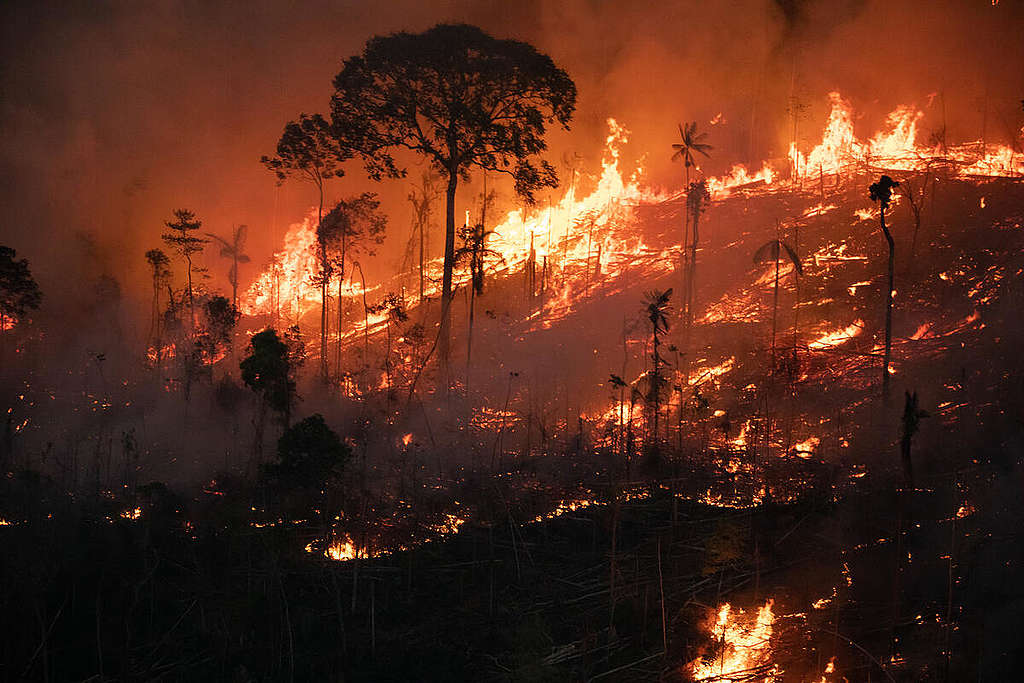
Amazon wildfires have an immediate and visible climate impact.
They burn vegetation, release carbon dioxide, damage habitats and generate smoke that affects human health across large regions.
But the direct emissions from combustion are only part of the carbon story.
New research led by the University of Exeter, with collaborators at ETH Zurich and James Cook University, finds that ground-level ozone produced by Amazon wildfires weakens the capacity of surviving forest to absorb carbon dioxide after fires have occurred.
The researchers estimate that ozone damage reduces Amazon carbon uptake by an amount equivalent to around 24% of the carbon emitted directly by fires. The effect is strongest during major droughts, when fire activity, atmospheric pollution and plant stress interact.
This has important implications.
A wildfire is not only an emission event.
It can also degrade the future functioning of a carbon sink.
For companies, investors and policymakers relying on forests as part of climate strategies, that distinction matters.
The direct carbon calculation is incomplete
A standard wildfire emissions estimate focuses on combustion.
It asks how much carbon stored in trees, understory vegetation and dead organic matter was released into the atmosphere when the fire burned.
That is necessary.
But it can miss the secondary effect.
A simplified carbon-balance framework is:
Net climate impact of fire=direct fire emissions+post-fire loss of carbon uptake+other atmospheric effects−any subsequent regrowth
The second term is critical.
A forest that survives a fire may look intact in satellite imagery. However, if ozone pollution damages leaf tissue or disrupts stomatal function, the trees may absorb less CO₂ for months or years afterwards.
The forest remains standing.
Its carbon-sink function is weakened.
How wildfire smoke creates ozone
Ground-level ozone is not emitted directly by a forest fire.
It forms in the atmosphere when pollutants including nitrogen oxides and volatile organic compounds react in sunlight.
Wildfires produce many of the ingredients needed for this chemistry.
Once formed, ozone can enter leaves through stomata—the microscopic pores plants use to exchange gases with the atmosphere.
That is where the problem begins.
Plants need stomata to take in CO₂ for photosynthesis. But ozone entering through the same pathway can damage cells, disrupt photosynthetic processes and reduce plant growth.
The result is a reduction in gross primary productivity: the amount of carbon plants remove from the atmosphere through photosynthesis.
In a major carbon sink such as the Amazon, even a relatively small change in photosynthesis can have climate significance.
Why drought makes the effect worse
The researchers found that ozone-related carbon losses were most pronounced during major droughts.
This is expected.
Drought affects tree physiology, soil moisture, leaf temperature and fire susceptibility. It can also reduce a forest’s ability to recover from disturbance.
At the same time, drought can increase the likelihood of fires and extend their duration.
The study examined nearly three decades of observations and used a global vegetation model to assess the relationship between fire activity, ozone damage and carbon uptake from 1997 to 2024. It identifies the 1997/98, 2015/16 and 2023/24 Amazon droughts as periods with particularly strong impacts.
The research warns that a strengthening El Niño could increase the risk of similar effects again.
El Niño does not cause climate change. But it can amplify heat and drought against an already warmer climate baseline.
That matters because forest-carbon risk is not static.
A project’s risk profile can change quickly when climate variability, land clearing, drought and fire interact.
The “Arc of Deforestation” shows why land use and air quality cannot be separated
The highest ozone damage identified by the research was concentrated in the Amazon’s “Arc of Deforestation,” where land conversion and agricultural expansion have historically increased pressure on forest systems.
This matters because fire, air pollution, deforestation and carbon loss are often treated as separate policy problems.
They are not.
Land clearing can create ignition sources and fragmented forests. Fire smoke can generate ozone. Ozone can reduce the photosynthetic performance of surviving trees. Weakened forests can become more vulnerable to drought, disease and future fire.
The feedback loop can be represented as:
Deforestation and degradation→fire activity→smoke precursors→ground-level ozone→reduced photosynthesis→weaker carbon sink
This is a systems-risk problem.
It cannot be solved by measuring only tree cover.
Implications for forest-carbon projects
Forest-carbon methodologies typically account for risks such as deforestation, illegal logging, fire, pests and storms.
The new findings suggest that smoke-derived ozone should receive more attention in carbon-risk assessments, particularly for tropical forests exposed to drought and repeated fires.
For project developers and buyers, relevant questions include:
Does the project face recurring wildfire-smoke exposure?
Are regional ozone concentrations monitored or modelled?
How is post-fire reduction in carbon uptake treated?
Are buffer pools sufficient to cover secondary ecosystem impacts?
Does the project rely on assumptions that surviving forest immediately resumes normal growth?
Are climate-risk models updated for drought and El Niño conditions?
Are leakage and displacement of agricultural burning considered at landscape scale?
These questions do not mean forest-carbon projects are unsuitable.
They mean the measurement and risk-management standard needs to improve.
Forest carbon is a biological asset with variable performance
Carbon stored in forests is often discussed as though it were equivalent to carbon stored in a tank or geological reservoir.
It is not.
Forests are living systems.
Their carbon uptake varies with temperature, rainfall, CO₂ concentration, nutrient availability, ozone exposure, species composition, age, fire history and human intervention.
A forest may store substantial carbon while its future rate of uptake declines.
It may recover after a disturbance—or transition into a less productive ecological state.
That does not diminish the value of protecting forests.
It strengthens the case for protecting them before damage accumulates.
A more complete climate case for stopping fires
The Exeter research changes how wildfire mitigation should be framed.
Preventing deforestation and fire does not only avoid direct combustion emissions.
It also protects the carbon-absorption capacity of the forest that remains.
That produces a double climate benefit:
Less CO₂ released from burning biomass.
Less ozone-driven damage to the forest’s ability to remove CO₂ afterwards.
For policymakers, this reinforces the need to integrate forest protection, agricultural policy, fire management, air-quality monitoring and climate finance.
For businesses buying nature-based credits, it reinforces the need for project-level due diligence that goes beyond satellite-based forest-cover measurements.
For investors, it highlights that physical climate risk can affect the performance of natural capital in ways that are not immediately visible.
The Amazon is not only a carbon stock
The Amazon is often described as a carbon store.
That is true.
But it is also a functioning carbon-processing system, continuously exchanging CO₂ with the atmosphere through photosynthesis, respiration, decomposition and disturbance.
Wildfire ozone reduces the performance of that system.
The implication is clear.
The cost of fire is larger than the smoke plume.
It includes the carbon the forest would otherwise have absorbed.