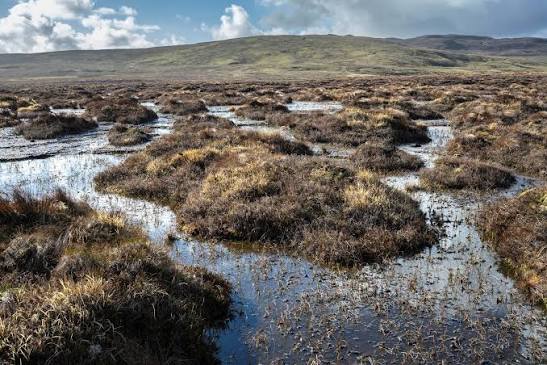
Peatlands are frequently described as natural climate assets.
They store carbon accumulated over thousands of years. They regulate water. They support biodiversity. They can reduce emissions when degraded areas are restored and rewetted.
But “natural” does not mean risk-free.
New modelling research from the University of Nottingham suggests that peatlands may have less capacity to store carbon than some projections assume. The study found that, as peat builds up and becomes heavier, it can reach physical limits where it is more likely to crack, move or slide—particularly on sloping land.
This matters because peatland restoration is increasingly linked to carbon markets, biodiversity finance, water-company investment, land-management policy and corporate nature strategies.
The headline lesson is important:
A peatland’s carbon value depends not only on how much carbon it contains, but on whether that carbon can remain physically secure over time.
For restoration practitioners, carbon-credit buyers, investors, landowners and policymakers, permanence needs to include geology, hydrology and mechanical stability—not only carbon-accounting methodology.
A major carbon store with physical limits
Peatlands form as partially decomposed plant material accumulates in wet conditions. Waterlogged environments slow decomposition, allowing carbon-rich organic matter to build up over centuries and millennia.
They occupy around 3% of global land area but play a disproportionately important role in carbon storage. In the UK, peatlands cover approximately 12% of land area and are central to national efforts on climate mitigation, biodiversity recovery, water quality and flood management.
That value is real. But so are the constraints.
The University of Nottingham study used simulation modelling to examine how peat accumulates across a 500-metre landscape containing upland, slope and lowland conditions. The researchers varied the slope from 0 to 12 degrees and modelled rainfall, drainage, plant growth and peat accumulation over thousands of years.
Their findings suggest that peatlands may only expand to around 1.48 times their current volume, compared with 1.71 times under assumptions used in some existing carbon-storage projections. In practical terms, that means a significant amount of future carbon storage may never materialise if the peat becomes physically unstable before reaching the expected depth.
Why stability affects carbon permanence
When peat becomes too deep or heavy for its underlying conditions, especially on slopes, the material can fracture, slump, slide or erode.
This can lead to carbon losses in several ways:
Exposed peat can dry out and oxidise, releasing carbon dioxide.
Erosion can transport organic carbon into rivers and water bodies.
Landslides and mass movement can disturb vegetation and hydrology.
Damaged peat can become harder and more expensive to restore.
Extreme rainfall or prolonged drought can increase stress on already vulnerable systems.
The relationship can be expressed simply:
Carbon storage potential≠secure long-term carbon storage
A project may contain large quantities of carbon, but if its hydrology, slope, peat depth and management conditions create a meaningful risk of erosion or collapse, that carbon benefit is less durable than it appears on paper.
This has direct relevance for natural-capital valuation and carbon-credit integrity.
Rewetting remains essential—but it needs risk assessment
The study does not argue against peatland restoration or rewetting.
Rewetting degraded peatlands remains one of the most important actions available for reducing emissions from drained organic soils. Drained peat can release significant quantities of carbon dioxide, while healthy wet peatland can support long-term carbon retention, water regulation and biodiversity.
However, restoration changes water levels and water movement.
In some landscapes, particularly where peat is deep or located on slopes, those hydrological changes may affect physical stability. This does not mean rewetting should be avoided. It means restoration needs site-specific planning.
A credible restoration process should assess:
Peat depth and condition
Ground slope and local topography
Historical erosion, cracking or landslide activity
Drainage patterns and water-table management
Rainfall intensity and future climate projections
Vegetation cover and root structure
Downstream exposure, including roads, rivers, communities and infrastructure
Long-term monitoring and emergency-response arrangements
This is a more mature approach to nature-based climate action: protecting carbon while understanding the physical conditions that make that protection durable.
What it means for carbon projects
Peatland carbon projects often rely on expected emissions reductions from restoration, improved land management or avoided degradation.
Those benefits can be credible. But buyers should not assume that a peatland project carries no permanence or delivery risk simply because it is nature based.
Due diligence should include both carbon-accounting questions and landscape-stability questions.
Buyer question | Why it matters |
|---|---|
What is the peat depth across the project area? | Deeper peat can contain more carbon but may also create greater stability considerations |
Is the project located on sloping terrain? | Slope can influence erosion, cracking and mass-movement risk |
What is the site’s hydrological condition? | Water management influences carbon retention and physical stability |
Has the site experienced erosion or peat movement before? | Historic instability can indicate future risk |
How will rewetting alter water flows? | Restoration can change local hydrology and must be designed carefully |
What monitoring is planned? | Ongoing monitoring supports early detection of erosion, subsidence or drainage failure |
Who bears the risk if carbon benefits are reduced or reversed? | Contracts, buffer mechanisms and project governance should clarify liability |
These questions are relevant to corporate buyers, project developers, insurers, landowners, lenders and public-sector funders.
A wider lesson for nature finance
The growth of nature-based climate finance has created a welcome focus on forests, wetlands, soils and coastal ecosystems.
But it has also created a risk of over-simplification.
Natural systems are dynamic. They can provide substantial climate value, but they are also exposed to drought, fire, disease, land-use change, flooding, erosion and governance failures. The quality of a project depends on whether these risks are recognised and actively managed.
The peatland research reinforces a principle that applies across the market:
Nature-based carbon projects should be assessed as living, physical systems—not only as projected credit volumes.
That requires stronger baseline data, transparent assumptions, long-term monitoring, locally appropriate restoration design and honest communication about uncertainty.
The investment case for better assessment
Some may view additional stability assessment as another cost or barrier to peatland restoration.
It should be seen differently.
Better site assessment can reduce the risk of failed interventions, avoid damage to downstream infrastructure, improve the reliability of carbon estimates and protect the reputation of project developers and buyers.
It can also direct capital to the places where restoration is most likely to deliver durable benefits.
For public and private investors, the best peatland projects will not necessarily be those promising the largest short-term volume of credits. They will be those that combine carbon benefit with ecological integrity, water resilience, sound engineering and credible long-term stewardship.
From carbon potential to carbon security
Peatlands remain one of the UK’s most valuable natural assets.
Their restoration should continue at scale. But carbon potential and carbon security are not the same thing.
As climate finance moves toward higher-integrity nature-based solutions, physical stability must become part of the conversation. Peat depth, slope, water movement and erosion risk may sound technical, but they are fundamental to whether a project can deliver the climate outcomes it promises.
For carbon markets and natural-capital investors, the standard should be clear:
Do not only ask how much carbon a landscape could store.
Ask whether the carbon can remain there.