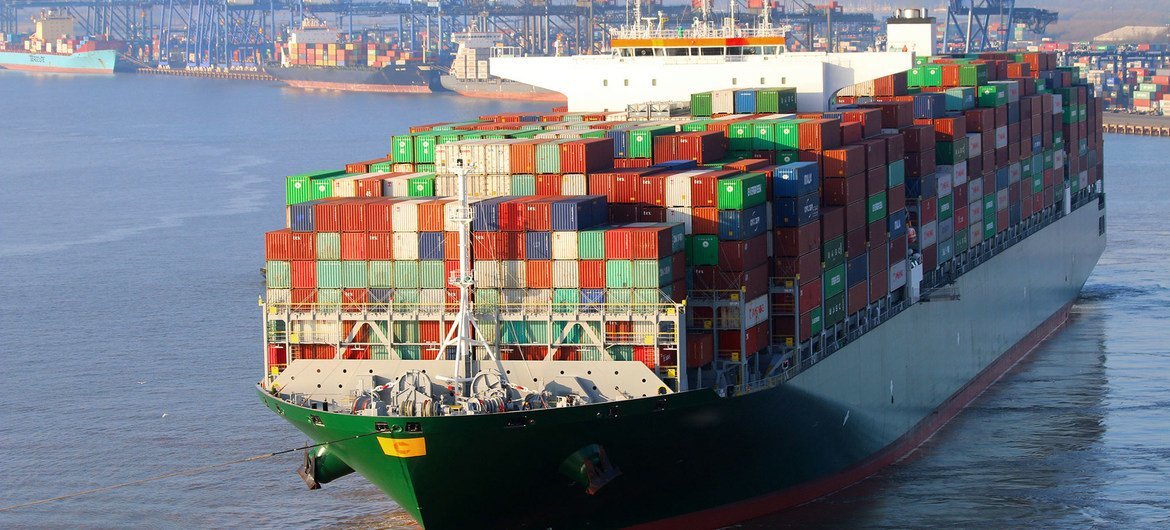
Shipping is one of the most international parts of the global economy.
A container may be manufactured in Asia, assembled in Europe, financed in London, insured in Bermuda, sold in the United States and delivered through multiple ports before reaching its final buyer. Yet the fuel used to move that cargo has historically been governed through a patchwork of national rules, regional carbon markets and voluntary commitments.
That is why the International Maritime Organization’s proposed Net-Zero Framework matters.
The framework would create a global approach to reducing greenhouse-gas emissions from international shipping, combining a fuel standard with an economic mechanism intended to place a cost on emissions and direct revenue toward the transition. Recent IMO discussions have shown majority support for retaining carbon pricing and the revenue mechanism at the centre of the framework, but negotiations remain contested and formal adoption has been deferred to an extraordinary meeting expected in December 2026.
This is not a technical maritime-policy dispute.
It is a test of whether the world can create a credible carbon-pricing system for a sector whose emissions, vessels, fuel supply and commercial contracts cross national borders every day.
Why global shipping needs a global approach
Shipping already faces multiple climate-policy pressures.
The European Union has brought maritime emissions into the EU Emissions Trading System. The FuelEU Maritime regulation is creating incentives for cleaner fuels on relevant voyages. National and regional rules are developing elsewhere. Cargo owners increasingly ask logistics providers for emissions data. Banks and insurers are assessing transition risk. Ports are considering future infrastructure for low-carbon fuels.
These developments are moving the sector, but they also create fragmentation.
A ship trading internationally can face different rules depending on where it calls, what cargo it carries, how its voyage is structured and which entity is contractually responsible for fuel or emissions costs.
A global framework could help establish a more consistent baseline.
The proposed IMO model is intended to combine two linked elements:
A global fuel-intensity standard, designed to encourage lower-emission maritime fuels over time.
An economic mechanism, often described as a greenhouse-gas pricing or revenue system, which would apply financial consequences to vessels that fail to meet relevant performance thresholds.
According to legal and industry analysis of the proposal, vessels that do not meet the base target could face a higher penalty, while vessels that meet the base target but not a more ambitious direct-compliance threshold could face a lower carbon-price tier. The exact design remains subject to negotiation.
The principle is straightforward: cleaner fuel choices and better operational efficiency should become more commercially attractive than continued reliance on conventional fossil fuels.
The December decision is about more than price
Carbon pricing is the headline issue because it determines who pays, how much and where the money goes.
But the December negotiations will also influence several deeper questions.
What counts as a lower-emission fuel?
The answer affects investment in green methanol, ammonia, hydrogen-derived fuels, biofuels, synthetic fuels, electrification, wind-assist technologies and energy-efficiency upgrades.
How will fuel lifecycle emissions be measured?
A credible system needs to consider more than emissions at the ship’s funnel. It must address production pathways, feedstocks, electricity sources, methane leakage and other lifecycle effects where relevant.
How will revenue be used?
Industry reporting estimates that a global shipping carbon-pricing mechanism could generate between $10 billion and $15 billion annually. The allocation of that revenue is politically important: it could support fuel innovation, fleet transition, port infrastructure, developing countries and measures to address disproportionate impacts on vulnerable economies.
How will the transition be made equitable?
Small island states and developing countries may be highly exposed to higher freight costs, even though they have contributed comparatively little to historical emissions.
A global system will need credible provisions for fairness, support and distributional impacts.
Will the framework be strong enough to change investment decisions?
A low or uncertain price signal may not unlock large-scale investment in new fuel supply chains. But a predictable and credible policy pathway can reduce uncertainty for shipowners, fuel producers, ports, financiers and cargo owners.
The real question is therefore not only whether the IMO agrees a carbon price.
It is whether the agreement creates a sufficiently durable investment framework for a sector with long-lived assets and high infrastructure dependence.
Shipping’s transition is a fuel-system transition
The maritime industry cannot decarbonise by changing one fuel overnight.
New fuels require new supply chains. Ships may need different engines, tanks, safety systems and fuel-handling equipment. Ports may need bunkering infrastructure, storage, training and emergency-response capability. Fuel producers need demand certainty before committing capital to large-scale production. Cargo owners need to understand potential cost pass-throughs in freight contracts.
This creates a classic transition-finance challenge.
No individual actor controls the complete system:
Shipowners decide when to order, retrofit or retire vessels.
Charterers influence vessel deployment, speed, fuel choices and commercial incentives.
Fuel producers decide whether to invest in new supply.
Ports decide whether to build bunkering and storage capacity.
Banks, insurers and leasing companies influence access to capital.
Governments set the regulatory environment.
Cargo owners create demand for lower-emission freight services.
A global IMO framework cannot solve every problem. But it can provide a common direction of travel that allows these actors to make decisions with greater confidence.
What cargo owners should understand
Shipping decarbonisation is often presented as an issue for vessel operators. In reality, cargo owners will increasingly feel its effects through procurement, logistics planning and Scope 3 reporting.
Companies that import or export substantial volumes should begin asking:
Which shipping lanes and carriers are most material to our emissions footprint?
Do our freight contracts identify how carbon-related costs will be allocated?
Are we receiving credible voyage-level or carrier-level emissions data?
Which carriers have a practical fuel-transition strategy rather than a distant ambition?
Could lower-emission freight become a competitive factor in customer tenders or product claims?
Are our procurement teams able to compare freight offers on cost, reliability, emissions intensity and future regulatory exposure?
For many businesses, logistics emissions sit in Scope 3. That does not mean they are outside commercial control.
Longer-term contracts, demand aggregation, carrier selection, route optimisation, loading efficiency, modal decisions and service-level expectations can all influence the emissions profile of freight.
The most important shift is conceptual: shipping emissions should no longer be treated as an uncontrollable line in a supplier footprint. They are increasingly a supply-chain and procurement issue.
The finance question: stranded fuel or strategic asset?
For investors, lenders and insurers, shipping’s transition raises a difficult asset question.
A vessel ordered today may operate for decades. The fuel, engine and infrastructure choices made now will shape its compliance costs, resale value, charter attractiveness and financing profile well into the 2030s and beyond.
That creates risk on both sides.
A ship designed around conventional fuel may face increasing exposure to carbon costs, fuel standards and customer pressure. But a ship designed for an emerging fuel pathway may face uncertainty about fuel availability, price, safety standards and port infrastructure.
The strongest investment decisions will therefore assess the full transition system:
Fuel flexibility and retrofit potential.
Expected availability of lower-emission fuels on relevant trading routes.
Exposure to regional and international carbon rules.
Contractual pass-through of fuel and compliance costs.
Port-readiness and bunkering access.
Cargo-owner demand for lower-emission services.
Access to green, transition or sustainability-linked finance.
Residual-value scenarios under different policy outcomes.
The December negotiations will matter because policy clarity can reduce some of this uncertainty. A credible global signal could encourage earlier investment in fuel production and fleet upgrades. Continued delay or a weak framework could increase fragmentation and leave companies reliant on regional rules and bilateral commercial solutions.
A practical readiness plan
Businesses involved in maritime trade do not need to wait for the final IMO text before taking action.
Map exposure.
Identify material shipping routes, freight spend, key carriers, vessel types and emissions hotspots.
Review contracts.
Examine bunker-adjustment factors, fuel surcharges, carbon-cost clauses, data-sharing obligations and responsibility for regulatory compliance.
Improve emissions evidence.
Request consistent logistics emissions data from carriers and freight forwarders. Understand the calculation methodology, boundary, reporting period and level of granularity.
Engage carriers.
Ask how they are preparing for fuel standards, carbon pricing, new-fuel procurement and vessel efficiency requirements.
Build scenarios.
Model how higher fuel costs, carbon charges or supply constraints could affect procurement costs, product margins, lead times and supplier relationships.
Align claims with evidence.
If a company describes freight or products as lower carbon, it should be able to explain the relevant route, fuel, methodology and evidence—not rely on broad logistics narratives.
The global test
Shipping is often described as difficult to decarbonise because it is global, capital-intensive and dependent on energy-dense fuel.
Those characteristics are precisely why the IMO outcome matters.
A well-designed global framework could help coordinate a transition that no country, port, carrier or cargo owner can deliver alone. It could reward efficiency, help finance cleaner fuels, support vulnerable economies and make emissions a clearer commercial variable across global supply chains.
A weak agreement would not stop shipping’s transition. Regional regulation, customer demand, fuel innovation and investor pressure will continue. But the result could be a more fragmented and costly pathway, with overlapping rules and uneven incentives.
December is therefore not only a date for maritime negotiators.
It is a strategic decision point for anyone who depends on global trade.
Sources
International Maritime Organization — 2023 IMO Strategy on Reduction of GHG
International Maritime Organization — Marine Environment Protection Committee
Maritime Executive — IMO concludes next round of Net-Zero discussions still divided
gCaptain — IMO Net-Zero Framework holds ground after latest round of climate talks
Holland & Knight — IMO Net-Zero Framework and shipping carbon-price implications