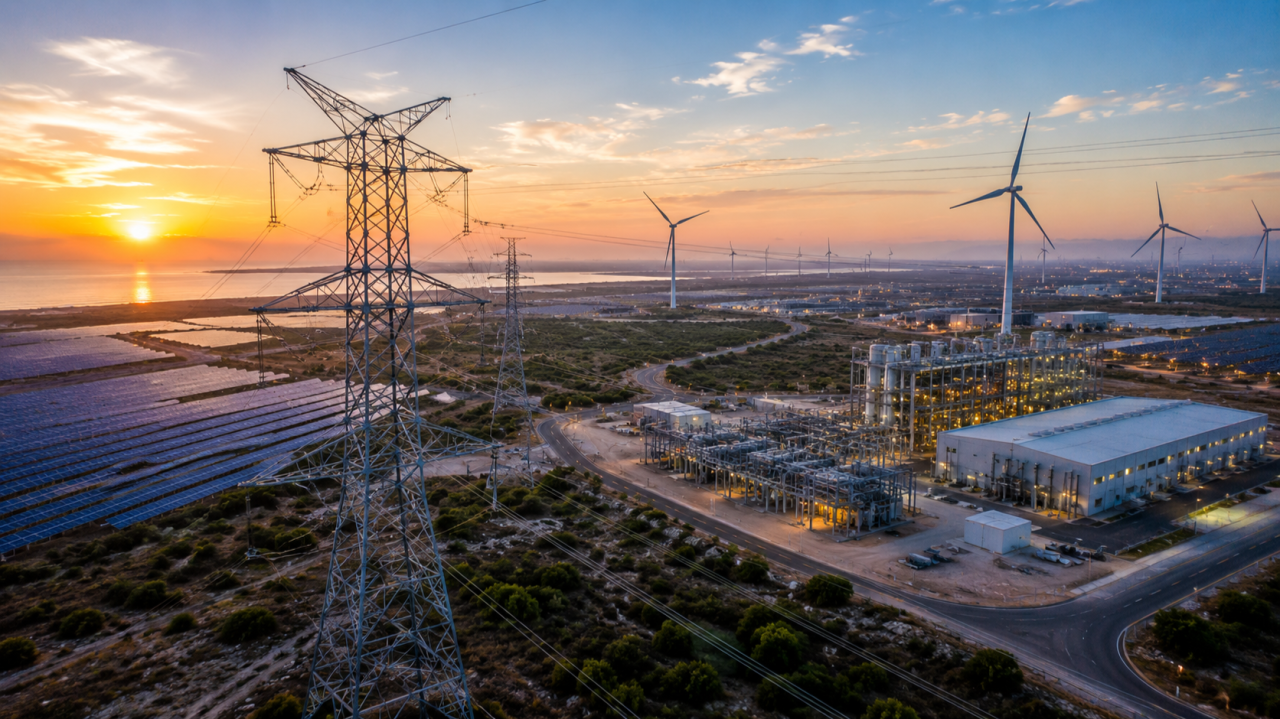
For more than a decade, the energy transition has been measured largely through the growth of renewable generation.
How much solar capacity was added? How many gigawatts of wind were installed? How quickly are coal plants closing? What share of electricity now comes from low-carbon sources?
These remain important measures. But they are no longer sufficient.
The next phase of the transition will be determined by whether power systems can connect, move, store, balance and intelligently use low-carbon electricity at the speed required by electrification.
The transition is becoming a grid transition.
A clean-energy system is not simply a larger collection of solar panels, wind turbines and batteries. It is a coordinated network in which generation, transmission, distribution, storage, industrial demand, electric vehicles, buildings, data centres and consumers must increasingly respond to changing conditions in real time.
That is an infrastructure challenge, a digital challenge, a planning challenge and an investment challenge.
Capacity is not the same as system capability
A country can have a large pipeline of renewable projects and still face major barriers to decarbonisation.
A wind farm cannot reduce emissions if it cannot connect to the network. Solar power cannot fully displace fossil generation if the system lacks the flexibility to manage evening demand. Batteries cannot provide their full value if market rules do not reward fast response. Electrified factories cannot plan investment confidently if grid-connection dates are uncertain.
This is the essential distinction between generation capacity and system capability.
Generation capacity tells us how much electricity a project could produce under the right conditions.
System capability tells us whether the wider network can absorb that electricity, move it to where it is needed, maintain reliability during periods of low renewable output, support new demand and recover from disruption.
The International Energy Agency has highlighted that as wind and solar shares rise, power systems require greater flexibility to manage variability in output. In a pathway aligned with national climate goals, it estimates that the need for system flexibility doubles between 2022 and 2030.
That is why the energy transition is not only a question of how much clean energy is built. It is a question of how the entire electricity system operates.
The five building blocks of a resilient grid
A reliable low-carbon power system requires several components to work together.
1. Transmission and distribution networks
Electricity must move from where it is generated to where it is consumed.
This becomes more complex as generation shifts from large centralised power stations to distributed wind, solar, storage, community energy, rooftop generation and electrified end uses. Transmission networks must connect new renewable-resource areas to demand centres, while local distribution systems must manage more two-way flows of electricity.
Network expansion can take years because it involves planning, permitting, land access, engineering, supply chains and public acceptance. Delays can become a bottleneck for renewable deployment, industrial investment and housing development.
The European Commission’s Grids Package, presented in December 2025, is intended to unlock investment and bring European electricity grids up to speed as demand and generation patterns change.
2. Storage
Storage allows electricity to be used at a different time from when it is generated.
Short-duration battery storage can help balance hourly variations, manage peaks, support frequency stability and store surplus solar generation for use later in the day. Longer-duration storage, including pumped hydro, thermal storage, hydrogen-derived solutions and emerging technologies, may become increasingly important where systems need to manage multi-day, seasonal or weather-related gaps.
Storage should not be treated as a single product category. Different technologies solve different problems. The commercial question is not simply, “Do we need batteries?” It is, “What duration, location, response speed and revenue model does the system require?”
3. Demand flexibility
A modern grid should not rely only on adjusting supply. It should also be able to adjust demand.
Demand response can involve industrial users moving consumption away from periods of grid stress, commercial buildings managing heating and cooling loads, electric vehicles charging at lower-demand hours, or households responding to time-of-use signals through smart devices.
The IEA notes that demand-response providers can reduce peak-capacity requirements, defer grid investment, lower renewable-integration costs and strengthen system resilience during periods of stress.
For businesses, flexibility is becoming both an operational capability and a potential source of value. Companies with controllable load, onsite generation, storage or electric-vehicle fleets may be able to reduce energy costs, improve resilience and participate in flexibility markets — provided they have the data, controls and commercial arrangements to do so.
4. Interconnection and market design
Electricity systems become more resilient when they can share resources across wider geographic areas.
Interconnectors can help move electricity from regions with surplus generation to those facing tight supply. They can reduce the need for every country or region to maintain the same level of backup capacity. But they also require effective cross-border market design, operational coordination and rules that reflect the value of resilience.
Market design matters because investors respond to incentives. If networks, storage, demand response and clean dispatchable capacity are not rewarded for the services they provide, the system may underinvest in the assets needed for reliability.
5. Digital intelligence
A more decentralised, weather-dependent energy system creates vastly more data points and operational decisions.
Grid operators need improved forecasting for wind, solar, demand, hydrology, temperature, equipment conditions and network constraints. Energy users need visibility of consumption, tariffs, emissions intensity and flexibility opportunities. Investors need a clearer view of congestion, curtailment risk, connection timelines and revenue volatility.
Digital tools and AI can help forecast generation and demand, optimise asset dispatch, detect faults, manage congestion and coordinate distributed energy resources. The European Commission has identified digitalisation as a core element of the energy transition; its 2026–27 work programme includes approximately €100 million for advanced smart-grid solutions and €75 million for AI energy applications.
But digitalisation is not a substitute for wires, transformers, substations and storage. It is a force multiplier. It helps the existing and expanding system operate more efficiently, but it cannot eliminate the need for physical infrastructure.
The new pressure points
The grid challenge is intensifying because several trends are happening at once.
Renewable generation is increasing.
Transport, heating and industry are electrifying.
Data centres and AI infrastructure are adding significant new demand in some locations.
Extreme weather is increasing physical risks to power infrastructure.
Consumers are adding rooftop solar, heat pumps, batteries and electric vehicles.
Industrial clusters are seeking large new grid connections.
At the same time, old power stations are retiring and the system is losing some forms of dispatchable capacity that historically provided stability, inertia and flexibility.
The result is a more dynamic but more complex electricity system.
The IEA’s 2026 electricity analysis identifies grid and flexibility challenges as central to the evolving power sector, noting that more than 2,500 GW of renewable, large-load and storage projects are seeking connection worldwide.
Connection queues are not just administrative delays. They are signals that the pace of investment, planning and network delivery is failing to keep up with the pace of electrification and clean-energy development.
Why this matters for business
The grid transition will increasingly shape corporate competitiveness.
For energy-intensive businesses, electricity availability and price will influence decisions about location, expansion and decarbonisation investment. For property developers, grid access can determine whether new housing, commercial sites or industrial facilities can be built on schedule. For renewable developers, congestion and curtailment can materially change project economics. For lenders and investors, connection risk and power-price volatility can affect asset valuation and credit risk.
Businesses should therefore ask practical questions:
What is our exposure to grid congestion, price volatility and connection delays?
Can we reduce peak demand or shift flexible loads?
Do we have the data required to understand site-level electricity use and risk?
Could onsite solar, storage or demand-response participation improve resilience?
Are our decarbonisation targets dependent on grid upgrades that have not yet been delivered?
How will growing demand from electric vehicles, heat pumps, industry and data centres affect our locations?
Do our procurement contracts reflect changing power-market conditions?
These questions are not only for utility companies. They belong in corporate energy strategy, real-estate planning, procurement, investment analysis and climate-risk assessment.
Build for flexibility, not just volume
The old energy system was designed around relatively predictable demand and a smaller number of large generators.
The emerging system is more distributed, more electric, more weather-sensitive and more exposed to rapid changes in both supply and demand.
That makes flexibility a strategic asset.
Flexibility can come from batteries, pumped hydro, flexible industrial demand, smart charging, thermal storage, interconnection, dispatchable low-carbon generation, improved forecasting and better market rules. The optimal mix will vary by country, region and grid.
But the direction is clear.
A credible energy-transition strategy cannot be judged solely by how many gigawatts of renewable capacity it announces. It must also explain how electricity will be connected, balanced, stored, transmitted, secured and used efficiently.
The strongest economies will be those that treat grids as enabling infrastructure for industrial competitiveness, household affordability, energy security and climate delivery.
The most successful companies will be those that recognise the same shift early.
The energy transition is becoming a grid transition. The race is no longer only to build clean generation. It is to build a system capable of using it.